Proposal:Building passage
| building_passage | |
|---|---|
| Proposal status: | Approved (active) |
| Proposed by: | flaimo |
| Tagging: | tunnel,covered=building_passage,arcade,colonnade,avalanche_protector |
| Applies to: | 
|
| Definition: | Additional values for the tunnel key to deal with special situations of covered ways |
| Statistics: |
|
| Rendered as: | none |
| Draft started: | 2012-01-19 |
| RFC start: | 2012-01-19 |
| Vote start: | 2012-11-17 |
| Vote end: | 2012-12-01 |
Outline
After multiple discussion on the german forum and mailing list on how to tag roads and footways that go through a building, this proposal tries to sum up the results.
Currently there is no way to explicitly tag ways that go through a building, without actually being inside it (see example pictures below). The next best this is covered=yes, which doesn't provide enough information for renderers (especially for 3D maps) to differentiate between different kind of covered ways. Therefore the following values for the existing tunnel=* and covered=* keys are proposed:
Tagging
tunnel=building_passage
Ways that go through a building and have walls to all sides should be tagged with tunnel=building_passage. The building and the way share the same node at the entry and exit points of the building. The way is split at the entry and exit nodes and only the part covered by the building is tagged with tunnel=building_passage. The layer has to be the same as the building. So if the building doesn't have a layer tag, the way doesn't need one either.
When building_passage should not be used: It is not meant to be used for indoor mapping. The walls at both sides (and the top) of the tunnel are considered outer walls of the building, which can have entrances that lead into it (This proposal doesn't cover entrances inside building passages). For indoor mapping indoor=yes can be used. It is also not meant for ways that go through something else than a building.

Wullersdorf Pfarrhof Durchfahrt

Richard-Matthäi-Haus


covered=arcade
An arcade is a succession of arches, each counterthrusting the next, supported by columns or piers or a covered walk enclosed by a line of such arches on one or both sides.[1] Such ways should be tagged with covered=arcade. If the arcade is part of a building, the building and the way share the same node at the entry and exit points. The way is split at the entry and exit nodes and only the part covered by the building is tagged with covered=arcade The layer has to be the same as the building. So if the building doesn't have a layer tag, the way doesn't need one either. Use arcade:left=open or arcade:right=open to define which side of the way is open.
When arcade should not be used: It is not meant to be used for indoor mapping. The wall on one side is considered as an outer wall which can have entrances that lead into the building. For indoor mapping indoor=yes can be used. Also it is not meant to be used for simple roof overhangs or blind arcades.

A typical arcade in South Tyrol

covered=colonnade
Similar to arcades, but differ architecturally, a colonnade denotes a long sequence of columns joined by their entablature, often free-standing, or part of a building.[2] Such ways should be tagged with covered=colonnade. If part of a building, the building and the way share the same node at the entry and exit points. The way is split at the entry and exit nodes and only the part covered by the building is tagged with covered=colonnade The layer has to be the same as the building. So if the building doesn't have a layer tag, the way doesn't need one either. Use colonnade:left=open or colonnade:right=open to define which side of the way is open.
When colonnade should not be used: It is not meant to be used for indoor mapping. The wall on one side is considered as an outer wall which can have entrances that lead into the building. For indoor mapping indoor=yes can be used. Also it is not meant to be used for simple roof overhangs.
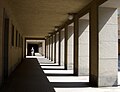
Kanslihusets arkad (misleading name, it's a colonnade, not an arcade)

The colonnade of famous Baroque architect Gian Lorenzo Bernini in front of St. Peter's in Rome


tunnel=avalanche_protector
A variant of "arcade" is tunnel=avalanche_protector and should be used in case of tunnels alongside mountains. These constructions stand for themself and are not attached to a building. Their purpose is to protect the highway or railway from avalanches and landslides. Use avalanche_protector:left=open or avalanche_protector:right=open to define which side of the way is open ("open" in case of avalanche protectors means, that light and air can enter on that side).
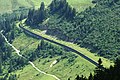
Damüls, Faschina Hahnenköpfle-Galerie

References
Changes based on comments from the RFC phase
- changed key from tunnel to covered for arcades (Fkv)
- added value colonnade; dropped building_ prefix (Dieterdreist)
- refined references to indoor mapping (Head)
- changed value from gallery to avalanche_protector (Vclaw)
Voting
Voting is now closed. 19 users voted "yes". Proposal has reached the minimum amount of 15 votes and 8 approving votes. The proposal is approved with a majority of 100%.
 I approve this proposal. --Flaimo 14:39, 17 November 2012 (UTC)
- I approve this proposal. --Surly 16:13, 17 November 2012 (UTC)
- I approve this proposal. --Dieterdreist 18:57, 17 November 2012 (UTC)
- I approve this proposal. This looks like a well thought out proposal. --RobJN 21:21, 17 November 2012 (UTC)
- I approve this proposal. --seav 03:47, 18 November 2012 (UTC)
- I approve this proposal. -- Al3xius 09:48, 18 November 2012 (UTC)
- I approve this proposal. --PanierAvide 09:58, 18 November 2012 (UTC)
- I approve this proposal. --MasiMaster 11:21, 18 November 2012 (UTC)
- I approve this proposal. ---R-michael 17:27, 18 November 2012 (UTC)
- I approve this proposal. -- Species 21:55, 18 November 2012 (UTC)
- I approve this proposal. --SimoneSVC 11:04, 19 November 2012 (UTC)
- I approve this proposal. HillWithSmallFields 15:44, 19 November 2012 (UTC)
- I approve this proposal. (except regarding the key choice for avalance_protector, see Fkv's remark below + talk page) --Tordanik 16:20, 19 November 2012 (UTC)
- I approve this proposal. --wambacher 22:20, 21 November 2012 (UTC)
- I approve this proposal. --wasat 23:05, 21 November 2012 (UTC)
- I approve this proposal. Except tunnel=avalanche_protector, which is obviously a mistake. As a variant of arcade, which you moved to the covered=* key, it must now be covered=avalanche_protector. See also section "tunnel vs. covered" on the discussion page, which you set to resolved giving "changed key to covered" as comment. BTW: I am sad that you completely ignored my suggestion to define the difference between tunnel and covered. --Fkv 04:10, 22 November 2012 (UTC)
- I approve this proposal. -- unixasket 15:09, 23 November 2012 (CET)
- I approve this proposal. --Schumi4ever 14:23, 23 November 2012 (UTC)
- I approve this proposal. -- rickmastfan67 20:57, 25 November 2012 (UTC)
