Key:hazmat

 hazmat hazmat
|
.svg) |
| Description |
|---|
Restrictions on vehicles transporting hazardous materials. 
|
| Group: restrictions |
| Used on these elements |
    |
| Useful combination |
|
| See also |
Status: approved
|
| Tools for this tag |
|


For marking of roads where transporting of hazardous materials is forbidden - or designated if such signs did exist.
Usage
Roads where transporting hazardous materials is forbidden can be tagged with hazmat=no.
Where local authorities divide hazardous materials into several groups, they might be appended with a colon, e.g. hazmat:A=no
Such divisions can be described on this page (on a per country basis if variations exist).
Common values
- designated
- no
- destination
- List of possible values with descriptions: see Key:access
- All used values on Taginfo
Tunnel restrictions
General EU restrictions
Since January 2010, a specific regulation is applied to the tunnel: There are five categories (A, B, C, D, E)
| Tunnel categories | The selected category fixes the list of dangerous goods whose transport is forbidden in the tunnel | Transport of dangerous goods authorized in the tunnel | Example |
|---|---|---|---|
| A | transport of dangerous goods without restrictions | B, C, D, E and dangerous goods without tunnel restriction code | Austria, B171, Kufstein-Pians, Stadtberg, code A, Note: required use of warning lamps in accordance with ECE regulation 65 |
| B | restriction on the transport of dangerous goods with a very large explosion range. | C, D, E and dangerous goods without tunnel restriction code. | Germany, A31, Leer, Ems, code B. |
| C | restriction on the transport of dangerous goods with a very long-range, long-range or long-range poisoning explosion. (gas or volatile liquid) | D, E and dangerous goods without tunnel restriction code. | France, A43, Modane-Bardonnechia(it), Frejus, code C, Note: Required escort for ADR classes 1 and 2. |
| D | restriction on the transport of dangerous goods that threaten a very long-range explosion, a long-range explosion or a large-scale poisoning or a large fire. | E and dangerous goods without tunnel restriction code. | Netherlands, A22, Velsen, Velsen, code D |
| E | The restriction applies to all dangerous goods except: UN 2919,3291, 3331, 3359, 3373) | dangerous goods without tunnel restriction code except: UN 2919,3291, 3331, 3359, 3373. | Germany, Hamburg, Kronstieg, code E, Note: 06:00-21:00. |
Dangerous goods without a tunnel restriction code correspond to the numbers NU 2919, 3291, 3331, 3359, 3373.
- https://www.tes.bam.de/en/regelwerke/tunnelvorschriften/index.htm
- EU minimum safety requirements for tunnels https://ec.europa.eu/transport/road_safety/topics/infrastructure/tunnels_en
Specific restrictions
| Example | Tag | Meaning |
|---|---|---|
 |
hazmat=no hazmat:conditional=yes @ (flashing_light) |
Vehicles with hazardous materials are only allowed to enter when using a flashing light. |
Country specifics
Finland
Use hazmat=no, but hazmat:B=destination - the auxiliary sign "VAK(B)" allows the transport to destination on that road, despite the name of the main traffic sign. Some places have a hazmat=designated to divert such traffic onto motorways.
Groups A and B exist. Their difference is (mostly) only in the amounts allowed, as defined separately for some 10 material classifications. Group B allows more of the materials. That is, for example less than 50 kg of explosives onboard is not a hazardous transport (by the signs, that is), any transport of 50 kg or more must obey they signs for group A (hazmat:A=*) and a transport of over 500 kg belongs to group B (hazmat:B=*).
France
Frequent use is hazmat=no.
The French government publishes an non-exhaustive list of tunnel here: Tunnels de + de 300 m - régime TMD - liste non exhaustive (Centre Étude des TUnel alias CETU) Most of them are groupe A or E.
Germany
In Germany exists a positive and negative network for transporting hazardous materials. Other streets should only be used to reach your destination. In water protection areas you can find special signs to protect water against contamination. For this we create a special subclass hazmat:water=*.
| hazmat=designated | Driving with hazardous materials explicitly encouraged (DE:Grundnetz Gefahrguttransporte) | |
 |
hazmat:water=permissive | Drivers of water contaminating materials should use a other route. |
 |
hazmat:water=no | Driving with water contaminating materials forbidden. |
 |
hazmat=no | Driving with hazardous materials forbidden. |
Additionally Germany uses the European tunnel categories A - E. Traffic sign DE:261 relate to hazardous materials, most times with attachment sign DE:1014-50, DE:1014-51, DE:1014-52 or DE:1014-53 to specify tunnel category. To specify access restrictions to ways these traffic signs should be translated to OSM-tags as followings:
| Sign | Tags | Meaning | Description type of goods |
|---|---|---|---|
|
hazmat=no |
No access for vehicles carrying hazardous substances. | No passage for any dangerous goods. |
,_StVO_2007.svg) |
hazmat:B=no | No access for vehicles carrying hazardous substances which are not allowed to pass tunnels of category B. |
No transit with dangerous goods that can lead to a very large explosion. |
,_StVO_2007.svg) |
hazmat:C=no | No access for vehicles carrying hazardous substances which are not allowed to pass tunnels of category C. |
Same restriction as for category B plus dangerous goods that can lead to a large explosion or extensive release of toxic substances. |
,_StVO_2007.svg) |
hazmat:D=no | No access for vehicles carrying hazardous substances which are not allowed to pass tunnels of category D. |
Same restriction as for category C but also corresponds to dangerous goods that can lead to large fire. |
,_StVO_2007.svg) |
hazmat:E=no | No access for vehicles carrying hazardous substances which are not allowed to pass tunnels of category E. |
No passage for any dangerous goods, with the exception of UN2919, UN3291 and UN3373 (certain radioactive materials, clinical waste and materials) |
Note:
For more details on type and amount of hazardous substances which are allowed to pass tunnel of a certain category, see Zweck des Tunnelbeschränkungscodes (TBC) (german).
Tunnel category A is specified but not required to be shown as traffic sign for road users as there are no restrictions for hazardous materials on this category. However, on tunnel entry portal you may find a plate like DE:1014-50 but showing letter A. This is for information only that this tunnel had been specified according to tunnel category A.
Guatemala

Netherlands
The Netherlands uses the European tunnel categories A - E. Traffic signs C22  and K14
  relate to hazardous materials. These are translated to OSM-tags in the following way:
| Sign | Tags | Meaning |
|---|---|---|
|
hazmat=no |
No access for vehicles carrying hazardous substances. |
[ B ] |
hazmat:B=no |
No access for vehicles carrying hazardous substances of category B or lower. (Tunnel category B) |
[ C ] |
hazmat:B=no |
No access for vehicles carrying hazardous substances of category C or lower. (Tunnel category C) |
[ D ] |
hazmat:B=no |
No access for vehicles carrying hazardous substances of category D or lower. (Tunnel category D) |
[ E ] |
hazmat:B=no |
No access for vehicles carrying hazardous substances of category E or lower. (Tunnel category E) |
|
Relation with:type=route |
Route for the transport of certain hazardous materials. |
Croatia
Croatia uses the European tunnel categories A - E, although these are not always marked on road signs. Instead, they are indicated with one or more of the following signs. Designated parking areas are sometimes provided where vehicles can be assessed and escorts prepared, for example, outside the Učka Tunnel.
The exact restrictions of tunnels and other roadways can be found at https://narodne-novine.nn.hr/clanci/sluzbeni/2012_10_114_2487.html.

Vehicles carrying liquid cisterns/tankers forbidden

Vehicles carrying explosive or highly flammable materials forbidden
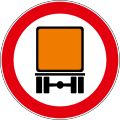
Vehicles carrying dangerous substances forbidden


United States
- Main article: w:Dangerous goods#United States

California:
hazmat=designated
California:
hazmat:waste=designated?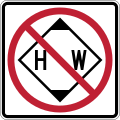
California:
hazmat:waste=no?


Hazardous cargo restrictions have generally been tagged using hazmat=no. As of November 2020, very few class-specific hazardous cargo access restrictions have been tagged in the United States, so far mostly in California. Following the general guidance above, one would use keys under the hazmat:* namespace to indicate specific restricted classes:

hazmat:1=no
hazmat:2.3=no
hazmat:4.3=no
hazmat:6.1=no
hazmat:7=no
hazmat:2.1:conditional=no @ bulk
hazmat:3:conditional=no @ bulk
hazmat:4:conditional=no @ bulk
hazmat:5:conditional=no @ bulk
hazmat:6:conditional=no @ bulk
hazmat:8:conditional=no @ bulk
On the highway=motorway_link way for the exit:
hazmat=designated
To determine the correct class for each placard, consult the following guides from the U.S. Department of Transportation:
- Nine Classes of Hazardous Materials (Yellow Visor Card)
- Hazardous Materials Markings, Labeling and Placarding Guide (DOT Chart 15)
- How to Comply with Federal Hazardous Materials Regulations
California signposts hazardous cargo restrictions using state-specific signs that do not explicitly include the placards:
Local transportation authorities may have their own detailed guides as well, such as this guide from the Port Authority of New York and New Jersey.
See also
- Conditional restrictions, corresponding to motor_vehicle:conditional=* @ (hazmat); which is favoured by Proposed features/Conditional restrictions over hazmat=* (and likely even more so for hazmat:conditional=*).
- Treaty ADR ("ADR" is derived from the French name for the treaty: Accord relatif au transport international des marchandises Dangereuses par Route) on wikipedia As of 2022, 53 states are party to ADR (for exemple, all land oF UE, UK, Swiss, Russia, Morocco, Turkey, Azerbaijan, etc ...)
- List of tunnel limitations in the transport of hazardous materials
- boundary=water_protection_area (de)
- access=*