Proposal:Crannog


The content of this proposal has been marked as archived to avoid confusion with the current version of the documentation.
To check whether the displayed page corresponds to the version at the time of archiving (end of voting),
the original revision can be accessed here: original compare with current
Proposal:Crannog
| crannog | |
|---|---|
| Proposal status: | Rejected (inactive) |
| Proposed by: | B-unicycling |
| Tagging: | settlement_type=crannog
|
| Applies to: | node, way, relation |
| Definition: | A crannog is a prehistoric artificial island/ islet created for human habitation. In some cases, a modern re-creation for educational purposes. |
| Statistics: |
|
| Draft started: | 2022-09-11 |
| RFC start: | 2022-09-22 |
| Vote start: | 2022-10-07 |
| Vote end: | 2022-10-21 |
Proposal
It is proposed to use the combination of historic=archaeological_site + site_type=settlement + settlement_type=crannog for historical sites of the crannog (aka crannóg) type. The combination should be used on areas, but if the exact extent is not known, a node can also be used.
![[W]](https://upload.wikimedia.org/wikipedia/commons/f/ff/Wikidata-logo.svg?utm_source=commons.wikimedia.org&utm_campaign=imageinfo&utm_content=original)
Rationale
Crannogs are a special type of prehistoric settlement form in the shape of artificial islands in Ireland, Scotland and Wales. Some had castles built on top in the Middle Ages, and some were inhabited as late as the 18th century (AD)[1]. They are found in lakes (water=lake), in wetlands (natural=wetland) and some even off the coast in the sea.
The wikipedia article claims that there are an estimated number of 1,200 in Ireland (110 are recorded in Co. Leitrim alone[2]), and that there 347 listed monuments for Scotland[3]. This would make these heritage features relevant enough to warrant their own tag.
Some of them turn out not to be crannogs after all after archaeological excavations, so it is up to each mapper to make a judgement call to map it as an archaeological site or not depending on the available information.
They can be found through local knowledge or historic maps (for example the British War office map for Ireland shows them).
Some have been re-created in modern times on heritage/ visitor sites and should have that marked with the addition of tourism=attraction.
Tagging
Prehistoric crannogs can be recognized on satellite imagery as an island with a circular (tree) outline or as circular features in the water. Reconstructed crannogs usually have one or more roof:material=thatch huts built on them.
| tag | explanation |
|---|---|
place=islet |
If still visible above water |
historic=archaeological_site |
Use for genuine pre-historic sites as well as reconstructions, because they fall under experimental archaeology |
site_type=settlement |
specify the historic site as a settlement |
settlement_type=crannog |
sub-classify as crannog |
Additional Tags
| tag | explanation |
|---|---|
historic:civilization=prehistoric |
if genuinely that old, for modern reconstructions, use historic:civilization=modern
|
heritage=* |
If certified as heritage. Use additional references according the the country applicable, where available. |
access=* |
These might be vulnerable sites, so please indicate if they are accessible to the public or not. |
Examples
-
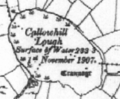 A crannog(e) in Co. Leitrim on the British War office map
 -
 A reconstructed crannog near Kenmore, Perth and Kinross, on Loch Tay, Scotland (show on OSM). The roundhouse burnt down in 2021, unfortunately.
 -
 Loughbrickland Crannóg in Northern Ireland (show on OSM)
 -
 Crannog and wood-turning, Irish National Heritage Park, Co. Wexford, Ireland (show on OSM)
 -
 Reconstruction of a crannog in Craggaunowen, Co. Clare (show on OSM)


Rendering
Like a historic site or tourist attraction, depending on what is the case.
Features/Pages affected
Further information
- Time Team Episode on a crannog in Scotland (see on OSM)
- Crannog on Wikipedia
- Crannogs in Irish folklore (duchas.ie)
- Prehistoric pile dwellings around the_Alps
References
External discussions
- Twitter (for
defensive_settlement=crannog) - Twitter (for
settlement_type=crannog) - in person with several archaeologists face-to-face or on WhatsApp (sorry, can't link that)
Comments
Please comment on the discussion page.
Voting
- Log in to the wiki if you are not already logged in.
- Scroll back down and click "Edit source" next to the title "Voting". Copy and paste the appropriate code from this table on its own line at the bottom of the text area:
| To get this output | you type | Description |
|---|---|---|
|
{{vote|yes}} --~~~~
|
Feel free to also explain why you support the proposal! |
|
{{vote|no}} reason --~~~~
|
Replace reason with your reason(s) for voting no. |
|
{{vote|abstain}} comments --~~~~
|
If you don't want to vote yes or no but do have something to say. Replace comments with your comments. |


~~~~ automatically inserts your name and the current date.For more types of votes you can cast, see Template:Vote. See also how vote outcome is processed.
 I approve this proposal. —Dieterdreist (talk) 08:25, 7 October 2022 (UTC)
- I approve this proposal. -- Something B (talk) 08:47, 7 October 2022 (UTC)
 I oppose this proposal. Thanks for your work on this! However, I think the parent keys and tags should be approved first (
historic=*,historic=archaeological_site,site_type=*,site_type=settlement,settlement_type=*). Sorry for not raising this during the RFC stage. I'm happy to help with proposing the parent tags. --Martianfreeloader (talk) 09:33, 7 October 2022 (UTC)
- you are opposing based only on formal reasoning, without any useful comment about the proposal? —-Dieterdreist (talk) 07:15, 12 October 2022 (UTC)
- I oppose this proposal. _type is a meaningless sufix, if we have to approve a key, we might as well approve
settlement=*Marc marc (talk) 10:22, 7 October 2022 (UTC)
- Until recently,
settlement=*was used in combination with the valuesyesandno(I think), so it was not available. It is now, so that might be an option indeed.B-unicycling (talk) 13:57, 11 October 2022 (UTC)
- Until recently,
 I have comments but abstain from voting on this proposal. I think it is best to deal with the previous two no-vote comments first, then restart the voting. --Peter Elderson (talk) 12:34, 7 October 2022 (UTC)
- I approve this proposal. --DIrish (talk) 18:47, 7 October 2022 (UTC)
- I have comments but abstain from voting on this proposal. Why not
historic=crannog, already a vast number of values forhistoric=*? This could avoid all the other tags? As for requiring thehistoric=*to be approved... over 1,500,000 of these on the data base, so no need for approval. If you want to change it Martin, put forward a proposal? Warin61 (talk) 04:14, 8 October 2022 (UTC)
- Indeed I find the problem fundamental in
historic=archaeological_site. If it's an "artificial island" or actually above-water structure, it might be more than archaeology. It's not totally clear how to use it when the archaelogy and physical remnant are mixed. Worse, there aresite_type=cityandsite_type=fortification, the former further conflicting with the format ofsite_type=settlement+settlement_type=town. Tag:site_type=settlement doesn't mentionsettlement_type=*at all, while suggestingsite_type=villageis a synonym. --- Kovposch (talk) 10:00, 8 October 2022 (UTC)- Archaeologists don't limit themself to dig under ground. They look at completely standing buildings, sites where part of the structure remain above ground or above water level.B-unicycling (talk) 18:03, 9 October 2022 (UTC)
- Should they be
historic=archaeological_sitethough? --- Kovposch (talk) 20:00, 9 October 2022 (UTC)- There have been Time Team episodes about them; I think that qualifies them as archaeological sites. B-unicycling (talk) 12:24, 11 October 2022 (UTC)
- Now I haven't watched that show, but for the sake of comparison: I see they made an episode "The Lost Submarine of WWI": Still
historic=wreck, nothistoric=archaeological_site? "The Lost WWI Bunker" ishistoric=bunker? They are something physical of their own, not in a pit below ground. --- Kovposch (talk) 20:00, 16 October 2022 (UTC)
- Now I haven't watched that show, but for the sake of comparison: I see they made an episode "The Lost Submarine of WWI": Still
- There have been Time Team episodes about them; I think that qualifies them as archaeological sites. B-unicycling (talk) 12:24, 11 October 2022 (UTC)
- Should they be
- Archaeologists don't limit themself to dig under ground. They look at completely standing buildings, sites where part of the structure remain above ground or above water level.B-unicycling (talk) 18:03, 9 October 2022 (UTC)
- Indeed I find the problem fundamental in
- I oppose this proposal. Mainly, approving
settlement_type=*is undesirable as mentioned.settlement=*would still to be checked for any conflicts between common types. Additionally,tourism=attractionshouldn't mean "Some have been re-created in modern times". That could be used for untouched archaeological sites that's a visitor spot at the same time. The properness ofbuilding:condition=*(forgot if there is another alternative along the lines ofmoved=*,maintained=*,anthropogenic=*, etc for the status) or similar for replicates other than buildings can be debated. --- Kovposch (talk) 09:43, 8 October 2022 (UTC)
- The re-constructions are usually (I believe) experimental archaeology; I think that counts as archaeological site, because archaeologists (and the general public) learn something from them. B-unicycling (talk) 12:26, 11 October 2022 (UTC)
- I oppose this proposal. The tagging hierarchy needs some work and should be fixed before specific values of sub-keys are approved (and thereby approving the hierarchy by default). Casey boy (talk) 09:11, 10 October 2022 (UTC)
- I approve this proposal. --EneaSuper (talk) 11:34, 16 October 2022 (UTC)
- I approve this proposal. --Reino Baptista (talk) 10:29, 17 October 2022 (UTC)
- I oppose this proposal. I'm not a big fan of "type" tags. Since they are rather ambiguous and I feel like the whole upper level tagging scheme thing needs to be sorted out before approving random subkeys. Otherwise your kind of putting the cart before the horse. Adamant1 (talk) 08:48, 20 October 2022 (UTC)
- I approve this proposal. I'm sympathetic to the unease about the historic hierarchy and *_type keys, but it's already widely used and documented. We can propose a "historic v2" scheme overhaul, but it shouldn't block this Crannóg refinement proposal. --Vincent De Phily (talk) 16:46, 20 October 2022 (UTC)
Voting on this proposal has been closed.
It was rejected with 6 votes for, 5 votes against and 2 abstentions.