OpenRailwayMap/Tagging in Luxembourg
This page is a draft and only contains suggestions.
General
Buffer stops
.jpg)
Buffer stops are usually equipped with an SFVb1  sign. This can be tagged as:
railway=buffer_stoprailway:signal:direction=*forwardif the OSM way of the track is directed towards the buffer stop,backwardif it is directed away from itrailway:signal:position=in_trackrailway:signal:minor=LU-CFL:SFVb1railway:signal:minor:form=sign
Telephones
.jpg)
.jpg)
.jpg)
Trackside telephones are marked with the letter T and are tagged as:
Signalling
Main signals
Main signals can occur on their own or combined with an integrated SFVb signal. The combined case can be identified by a blue and a white light in the bottom row (only one of which is turned on at a time). Note that we tag both cases differently to distinguish between them even without a detailed tagging of all states.
They may have additional dot-matrix-type indicators providing further information or modifying the meaning of the signal.
With the development of a new stage of ETCS Level 1 Full Supervision, first implemented on the Luxembourg–Troisvierges line, almost all traditional signals become obsolete. The only remaining signal is the new authorisation signal SFA, replacing the current main signal.
Signal fixe principal (SFP)

classic shape showing SFP1-
 SFP1
SFP1 -
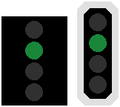 SFP2
SFP2 -
 SFP3
SFP3


railway:signal:main=LU-CFL:SFP
railway:signal:main:form=lightrailway:signal:main:states=LU-CFL:SFP1;LU-CFL:SFP2;LU-CFL:SFP3only enter the possible aspects at this signal (see images above)railway:signal:main:shape=compact/classic—compact= without white border (on the left in the above images);classic= with white border (on the right)railway:signal:main:function=*function of the signal (see key page for possible values)
Signal fixe principal (SFP) with integrated Signal fixe de voie barrée (SFVb)

compact shape showing SFP1, with additional displays for SFI (top) and SFCCI/O (bottom)-
 SFP1, tagged
SFPVb1 -
 SFVb2, tagged
SFPVb2 -
 SFP2
SFP2 -
 SFP3
SFP3


railway:signal:main=LU-CFL:SFPVbrailway:signal:main:form=lightrailway:signal:main:states=LU-CFL:SFPVb1;LU-CFL:SFPVb2;LU-CFL:SFP2;LU-CFL:SFP3only enter the possible aspects at this signal (see images above)railway:signal:main:shape=compact/classic—compact= rectangular (on the left in the above images);classic= upside-down T-shape (on the right)railway:signal:main:function=*function of the signal (see key page for possible values)
Signal fixe d’autorisation (SFA)

A light signal that can show a blue and a white light.
-
 SFA1
SFA1 -
 SFA2
SFA2 -
 SFA3
SFA3 -
 SFA signals are always marked by this arrow.


This signal is always marked by an ETCS Stop Marker  . Identically looking signals without this arrow marker are SFVb signals.
railway:signal:main=LU-CFL:SFArailway:signal:main:form=lightrailway:signal:main:states=LU-CFL:SFA1;LU-CFL:SFA2;LU-CFL:SFA3railway:signal:main:function=*function of the signal (see key page for possible values)
The corresponding stop marker is tagged on the same node:
railway:signal:train_protection=ETCS:markerrailway:signal:train_protection:main=ETCS:stop_markerrailway:signal:train_protection:main:form=sign
Distant signals
Signal fixe avancé (SFAv)
-
 SFAv1
SFAv1 -
 SFAv2
SFAv2 -
 SFAv3
SFAv3 -
 SFAv1 (repeated)
 -
 SFAv2 (repeated)
 -
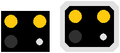 SFAv3 (repeated)


The distant signal indicates the state of an upcoming main signal.
When it repeats a previous distant signal, it is marked by a white light at the bottom right. The aspects of a repeated signal are known as SFAvR 1/2/3, but here they are tagged the same way as the non-repeated aspects (i.e. without an added letter "R"). The repeater signals are instead distinguished by the tag railway:signal:distant:repeated=yes.
It is marked by a distant signal board RF3  unless it is a repeater or located at the same position as a main signal.
It may have additional dot-matrix-type indicators providing further information or modifying the meaning of the signal.
railway:signal:distant=LU-CFL:SFAvrailway:signal:distant:form=lightrailway:signal:distant:states=LU-CFL:SFAv1;LU-CFL:SFAv2;LU-CFL:SFAv3;offonly enter the possible aspects at this signal (see images above)railway:signal:distant:repeated=yes/nowhether or not the signal has a white light at the bottom right (see images above)railway:signal:distant:shape=compact/classic—compact= without white border (on the left in the above images);classic= with white border (on the right)
Tableau de repèrage ou de substitution des signaux fixes avancés (RF3)
The distant signal board RF3 usually marks a distant signal. In that case it is not tagged separately.
On low-speed lines, it can occur instead of a distant signal. Only then it is tagged as follows:
Track protection signals
Signal fixe de voie barrée (SFVb)
Light signal

compact shapeA light signal that can show a blue and a white light. The lights can also be placed horizontally.
-
 SFVb1
SFVb1 -
 SFVb2
SFVb2


Note that an identically looking signal occuring together with an ETCS Stop Marker is not an SFVb signal, but an authorisation signal SFA! (It may still double as a track protection signal even with that marker if it is additionally marked by an RF7 plate. In that case it is still only tagged as an SFA together with RF7, not as an SFVb.)
railway:signal:minor=LU-CFL:SFVbrailway:signal:minor:form=lightrailway:signal:minor:states=LU-CFL:SFVb1;LU-CFL:SFVb2railway:signal:minor:shape=compact/classic—compact= without white border (on the left in the above images);classic= with white border (on the right)
Semaphore signal
-
 SFVb1
SFVb1 -
 SFVb2
SFVb2

railway:signal:minor=LU-CFL:SFVbrailway:signal:minor:form=semaphorerailway:signal:minor:states=LU-CFL:SFVb1;LU-CFL:SFVb2
Sign SFVb1
-
SFVb1
railway:signal:minor=LU-CFL:SFVb1railway:signal:minor:form=sign
Additional light signals
Signal fixe avancé indicateur de vitesse (SFAvI)

At distant signals showing SFAv3.
railway:signal:speed_limit_distant=LU-CFL:SFAvIrailway:signal:speed_limit_distant:form=lightrailway:signal:speed_limit_distant:speed=*list of possible speeds in km/h (displayed number × 10) includingoff, e.g.70;off
Signal fixe indicateur de vitesse (SFI)

At main signals showing SFP3. The standalone version is known as SFI/R.
railway:signal:speed_limit_distant=LU-CFL:SFIrailway:signal:speed_limit_distant:form=lightrailway:signal:speed_limit_distant:speed=*list of possible speeds in km/h (displayed number × 10) includingoff, e.g.70;off
Signal fixe avancé de réception sur voie en cul-de-sac, sur voie occupée ou sur voie non utilisable sur toute sa longueur (SFAvVo)

At distant signals showing SFAv3.
- Tagging?
Signal fixe de réception sur voie en cul-de-sac, sur voie occupée ou sur voie non utilisable sur toute sa longueur (SFVo)

At main signals showing SFP3.
- Tagging?
Signal fixe de changement du côté d'implantation des signaux – Panneau origine (SFCCI/O)

railway:signal:wrong_road=LU-CFL:SFCCI/Orailway:signal:wrong_road:form=lightrailway:signal:wrong_road:function=entry
Signal fixe de changement du côté d'implantation des signaux – Tableau fin (SFCCI/F)
Rectangular black board with two vertical white lines, one long and one short.

This signal can appear either as a board (sign) or a light signal (light).
railway:signal:wrong_road=LU-CFL:SFCCI/Frailway:signal:wrong_road:form=*signorlightrailway:signal:wrong_road:function=exit
Speed signals
Signal fixe annonciateur de la vitesse-infrastructure (SFAVI)
Yellow downward-pointing triangle with a black number.

This signal announces a permanent decrease in the speed limit marked by an upcoming SFIVI signal.
railway:signal:speed_limit_distant=LU-CFL:SFAVIrailway:signal:speed_limit_distant:form=signrailway:signal:speed_limit_distant:speed=*speed in km/h (number on the sign × 10), e.g.90
If there is another speed signal between the SFAVI and the announced SFIVI, the SFAVI is repeated at the intermediate signal where it is marked with an additional board reading "BIS". This repeated signal should additionally taged with
If the signal is placed before a switch and only applies to a certain direction, it is marked by an additional direction board and the applicable directions can be tagged with
railway:signal:speed_limit_distant:turn_direction=left/right/through
Signal fixe indicateur de la vitesse-infrastructure (SFIVI)
.jpg)
Green upward-pointing triangle with a white number.

This signal indicates a permanent change in the speed limit at its location.
railway:signal:speed_limit=LU-CFL:SFIVIrailway:signal:speed_limit:form=signrailway:signal:speed_limit:speed=*speed in km/h (number on the sign × 10), e.g.90
Signal mobile de ralentissement temporaire/Tableau annonciateur (SMR/A)
Yellow disk with a black number.

This signal announces a temporary speed limit marked by an upcoming SMR/EI signal.
railway:signal:speed_limit_distant=LU-CFL:SMR/Arailway:signal:speed_limit_distant:form=signrailway:signal:speed_limit_distant:speed=*speed in km/h (number on the sign × 10), e.g.90
Note that temporary objects should only be mapped when they will be in place for a considerable length of time.
Tableau d'exécution immédiate de ralentissement (SMR/EI)
White disk with a black number.

This signal indicates the start of a temporary speed limit at its location.
railway:signal:speed_limit=LU-CFL:SMR/EIrailway:signal:speed_limit:form=signrailway:signal:speed_limit:speed=*speed in km/h (number on the sign × 10), e.g.90
Note that temporary objects should only be mapped when they will be in place for a considerable length of time.
Tableau vert de reprise de vitesse (SMR/R)
Green disk with a white number.

This signal indicates the end of a temporary speed limit at its location and indicates the speed limit on the following track section.
railway:signal:speed_limit=LU-CFL:SMR/Rrailway:signal:speed_limit:form=signrailway:signal:speed_limit:speed=*speed in km/h (number on the sign × 10), e.g.90
Note that temporary objects should only be mapped when they will be in place for a considerable length of time.
Signal fixe indicateur de vitesse/Reprise de vitesse (SFI/R)
A white number on a black board or as a light display.
This signal increases the speed limit following a previous SFI signal. If it occurs at a main signal, it is not an SFI/R, but an SFI signal.
railway:signal:speed_limit=LU-CFL:SFI/Rrailway:signal:speed_limit:form=light/signvariable light signal or simple sign?railway:signal:speed_limit:speed=signlist of possible speeds in km/h (displayed number × 10), possibly includingoff, e.g.70;off
Chevron (RF1)
White board with black downward-pointing chevron symbol.

This sign marks the position at which a train must have reduced its speed after passing an SFP3 signal.
Level crossing signals
Signal fixe « Siffler » (SFS)
Rectangular board divided by its diagonals into 4 areas, the top and bottom one coloured in black. A black letter S on the left.

This sign indicates an upcoming level crossing. The train has to whistle here.
Signal fixe « Ralentir et Siffler »/Tableau annonciateur (SFRS/A)
Rectangular board divided by its diagonals into 4 areas, the top and bottom one coloured in yellow. A black number on the right.

This sign announces an upcoming SFRS/E sign.
railway:signal:crossing_distant=LU-CFL:SFRS/Arailway:signal:crossing_distant:form=signrailway:signal:crossing_distant:speed=*speed in km/h (number on the sign × 10), e.g.10
If the signal is placed before a switch and only applies to a certain direction, it is marked by an additional direction board and the applicable directions can be tagged with
railway:signal:crossing_distant:turn_direction=left/right/through
Signal fixe « Ralentir et Siffler »/Tableau d'exécution (SFRS/E)
Rectangular board divided by its diagonals into 4 areas, the top and bottom one coloured in green. A black letter S on the left, a black number on the right.

This sign indicates an upcoming level crossing. The speed limit (in km/h) is reduced to the number stated on the sign times 10. The train has to whistle here
railway:signal:crossing=LU-CFL:SFRS/Erailway:signal:crossing:form=signrailway:signal:crossing:speed=*speed in km/h (number on the sign × 10), e.g.10
Level crossing marker board
Rectangular white board with black letters PN followed by a number.
.jpg)
This sign indicates the number and position of a level crossing (passage à niveau, PN).
railway:signal:crossing_info=LU-CFL:PNrailway:signal:crossing_info:form=signrailway:signal:crossing_info:caption=*text on the sign, e.g.PN 41 PK 69,048(note that the decimal comma is often concealed by the mounting bracket)
The information on the sign can also be mapped on the node of the railway=level_crossing (not the node of the signal!) with
ref=*crossing number starting with "PN", e.g.PN 41railway:position:exact=*crossing location on the line stated at the bottom of the sign, e.g.69.048(here always with a decimal point instead of a comma)
Electrification signals
Signal fixe d'arrêt pour mouvements comportant un véhicule avec pantographe levé (ESFA)
Two blue diamonds side by side with a horizontal white line.

railway:signal:electricity=LU-CFL:ESFArailway:signal:electricity:form=signrailway:signal:electricity:type=end_of_catenary
Signal fixe commandant d'abaisser les pantographes/Tableau ou panneau annonciateur (ESFAp/TA)

railway:signal:electricity=LU-CFL:ESFAp/TArailway:signal:electricity:form=signrailway:signal:electricity:type=pantograph_down_advance
Signal fixe commandant d'abaisser les pantographes/Tableau ou panneau d'exécution (ESFAp/TE)

railway:signal:electricity=LU-CFL:ESFAp/TErailway:signal:electricity:form=signrailway:signal:electricity:type=pantograph_down
Signal fixe commandant d'abaisser les pantographes/Tableau ou panneau autorisant le relèvement du pantographe (ESFAp/TR)

railway:signal:electricity=LU-CFL:ESFAp/TRrailway:signal:electricity:form=signrailway:signal:electricity:type=pantograph_up
Signal fixe commandant de couper le courant sur l'engin moteur électrique/Tableau annonciateur (ESFCC/A)
White board with text "SECt à …".

This sign announces an upcoming ESFCC/E signal at the distance stated on the sign.
railway:signal:electricity=LU-CFL:ESFCC/Arailway:signal:electricity:form=signrailway:signal:electricity:type=power_off_advancerailway:signal:electricity:caption=*distance stated on the sign, e.g.500 m
Signal fixe commandant de couper le courant sur l'engin moteur électrique/Tableau d'exécution (ESFCC/E)

This signal marks the start of a section where the power of the locomotive must be turned off.
railway:signal:electricity=LU-CFL:ESFCC/Erailway:signal:electricity:form=signrailway:signal:electricity:type=power_off
Signal fixe commandant de couper le courant sur l'engin moteur électrique/Tableau indiquant la fin de parcours de coupure de courant (ESFCC/F)

This signal marks the end of a section where the power of the locomotive must be turned off. This signal indicates that the locomotive must be turned off.
railway:signal:electricity=LU-CFL:ESFCC/Frailway:signal:electricity:form=signrailway:signal:electricity:type=power_on
Repérage de l'endroit de commutation de tension (ERF103)
Blue diamond with white number

This sign indicates a change in catenary voltage to the stated value (kV).
railway:signal:electricity=LU-CFL:ERF103railway:signal:electricity:form=signrailway:signal:electricity:type=voltage_changerailway:signal:electricity:voltage=*voltage in V (number on the sign × 1000), e.g.25000
Other signals
Stop position marker
Square black board with a white number followed by the letter V.
.jpg)
This sign indicates the stopping position for trains made up of the given number of carriages at railway stations.
railway:signal:stop=LU-CFL:ArretVrailway:signal:stop:form=signrailway:signal:stop:for=vehiclesrailway:signal:stop:carriages=*number on the sign, e.g.7railway:signal:stop:caption=*full text on the sign, e.g.7V
Mirlitons (RF4)
Rectangular or square white board with 1 to 3 slanted black lines.

Distant signal beacons RF4 announce an upcoming distant signal in a distance of 250 m (3 stripes), 175 m (2 stripes) or 100 m (1 stripe).
railway:signal:distant=LU-CFL:RF4railway:signal:distant:form=signrailway:signal:distant:type=I/II/IIInumber of stripesrailway:signal:distant:height=normal/dwarfshape of the board (normal= thin rectangle as depicted above;dwarf= square /
/ /
/ )
)


Tableau-repère des signaux fixes lumineux commandant l'arrêt lorsqu'ils sont indûment éteints (RF7)
Red and white striped plate on the pole of light signals.

The plate on the left is used on standalone main signals, the plate on the right on SFVb as well as combined SFP/SFVb signals.
railway:signal:traversable=LU-CFL:RF7railway:signal:traversable:form=sign- TO DO: add applicable value for
railway:signal:traversable:type=*
Tableau d'annonce ou d'un point d'arrêt en pleine ligne (RF8)
Rectangular board, half black, half white

This sign announces an upcoming halt.
Tableau-repère des dispositifs répétant certain ralentissements temporaires rencontrés à revers (RF27)
Rectangular white board showing a stylised crocodile in black
.svg)
This sign is usually placed on the back of an SMR/A and indicates that the associated crocodile is not disabled for trains passing in the opposite direction.
Tableau-repère des crocodiles d'essai (RF28)
Rectangular white board showing a stylised crocodile with two on top in black
This sign indicates that a crocodile is placed at its location.
The presence of the crocodile can be tagged on the same node as:
Tableau-repère des crocodiles d'essai (RF30)
Rectangular white board with a black diagonal
This sign is placed together with speed limit signs and indicates the end of a section where switches occur.
railway:signal:switch=LU-CFL:RF30railway:signal:switch:form=sign
Signal fixe d'entrée (SFE)
White trapezoidal board with a black number, mounted on a pole with black and white stripes.

railway:signal:main=LU-CFL:SFErailway:signal:main:form=signrailway:signal:main:speed=*speed in km/h (number on the sign × 10), e.g.30
Signal fixe "Halte pour trains" (SFH)
Rectangular black board with white letter H

railway:signal:stop=LU-CFL:SFHrailway:signal:stop:form=sign
Signal fixe "Halte pour manoeuvres" (SFHM)
.jpg)
Semicircular white board with black text "Halte pour manoeuvres"

railway:signal:shunting=LU-CFL:SFHMrailway:signal:shunting:form=sign
Signal fixe indicateur de départ (SFID)

A light signal that can show a horizontal and diagonal white bar.
-
 SFID1
SFID1 -
 SFID2
SFID2


The departure indicator SFID shows the state of an authorisation signal SFA which may not be visible to the train guard on the platform. It is not designed as a technically safe light signal.
railway:signal:main_repeated=LU-CFL:SFIDrailway:signal:main_repeated:form=lightrailway:signal:main_repeated:states=LU-CFL:SFID1;LU-CFL:SFID2
Signal mobile d'arrêt (SMA)
.jpg)
Rectangular red board with white border.

railway:signal:minor=LU-CFL:SMArailway:signal:minor:form=sign
Signal mobile avancé (SMAv)
Yellow disk with white border.

railway:signal:minor=LU-CFL:SMAvrailway:signal:minor:form=sign
Example
.jpg)
The four signals in the image on the right can be tagged as follows:
 signal on the left:
railway=signalrailway:signal:direction=*forwardorbackward, depending on the direction of the OSM way of the trackrailway:signal:position=*leftorright, depending on the direction of the OSM way of the trackrailway:signal:catenary_mast=noref=W 745- main signal:
railway:signal:main=LU-CFL:SFPVbrailway:signal:main:form=lightrailway:signal:main:states=LU-CFL:SFPVb1and othersrailway:signal:main:shape=compactrectangular without white borderrailway:signal:main:function=*cannot be determined from the picture
- distant signal:
railway:signal:distant=LU-CFL:SFAvrailway:signal:distant:form=lightrailway:signal:distant:states=offand othersrailway:signal:distant:repeated=nono white light in the bottom rightrailway:signal:distant:shape=compact(rectangular without white border)
- additional signal:
- post plate:
signal on the right:
- same as above, except for:
ref=W 755railway:signal:main:states=LU-CFL:SFP2and othersrailway:signal:distant:states=LU-CFL:SFAv1and others
speed sign on the left:
railway=signalrailway:signal:direction=*forwardorbackward, depending on the direction of the OSM way of the trackrailway:signal:position=*leftorright, depending on the direction of the OSM way of the trackrailway:signal:catenary_mast=no- speed limit:
speed sign on the right:
- same as above, except for:
Sources
- Wikipedia: Signalisation ferroviaire luxembourgeoise (French)
- stellwerke.de: Signalsystem Luxemburg (German)
- Signal + Draht: ETCS Level 2 without GSM-R (German/English)