Proposal:Man made=guard stone


The content of this proposal has been marked as archived to avoid confusion with the current version of the documentation.
To check whether the displayed page corresponds to the version at the time of archiving (end of voting),
the original revision can be accessed here: original compare with current
Proposal:Man made=guard stone
| man_made=guard stone | |
|---|---|
| Proposal status: | Approved (active) |
| Proposed by: | b-unicycling |
| Tagging: | man_made=guard_stone
|
| Applies to: | 
|
| Definition: | A guard stone is in most cases a stone built onto or into the corner of a building or wall. They are usually found on either side of an entrance to a laneway or gateway. Guard stones may be put alongside a wall to protect it. Many are historical barriers that kept the wheels of carriages from damaging buildings. Some of them bear survey markers such as benchmarks. |
| Statistics: |
|
| Rendered as: | hidden |
| Draft started: | 2021-01-05 |
| RFC start: | 2021-01-05 |
| Vote start: | 2021-01-20 |
| Vote end: | 2021-02-05 |
Proposal
Guard stones or jostle stones are an architectural element and an often overlooked part of street furniture which has historical roots: To avoid collisions (jostling) between the wheels of horse-drawn carriages and the walls on either side of a lane or gateposts, guard stones were placed at entrances and sometimes along walls. Towns with a historic center still feature them. They are not necessarily made of stone, more recent examples are instead made of metal (Brandenburg Gate in Berlin uses decommissioned canons).
Rationale
Many guard stones are part of the historic heritage, feature local materials and are an indicator for the age of a building or street. Furthermore, they are obstacles for visually impaired or intoxicated pedestrians, as the example from Temple Bar shows: Woman who suffered 'minor in the extreme' injuries after pub fall loses €60k claim
Some examples go back to Roman times and they are generally very common in Europe. They differ from bollards in that they do not prevent access for vehicles, but as architectural elements rather protect buildings and in times gone by also vehicles from damage.
The majority of people taking part in the discussion about the objected proposal barrier=guard_stone felt that man_made was the better option, since guard stones do not limit access (in their opinion).
Examples
-
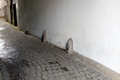 Guard stones protecting the wall of Chapel Lane in Kilkenny
-
 Guard stone (right) at the entrance to Pudding Lane, Kilkenny
-
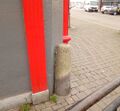 Guard stone in Kilkenny with a benchmark (crowsfoot) on it
-
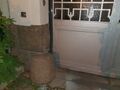 Example at a former printing house at Salomonstraße in Leipzig, Germany
-
 Two guard stones at the entrance to Turmstraße 70, Berlin, Germany
-
 Guard stones in Schlossstraße, Neustrelitz, Germany
-
 Guard stones on Seestraße, Neustrelitz, Germany
-
 Guard stone and bollard, Hoogstraat, Venlo


See Wikimedia for more examples from Northern Ireland, France, Belgium, Germany and other countries.
In other languages
| Language | word(s) for guard stone |
|---|---|
| English | jostle stone, chasse-roue |
| German | Prellstein, Radabweiser, Kratzstein, Abweichstein, Abweiser, Radstößer |
| French | chasse-roue, chasse-moyeux |
| Spanish | guardacantón |
| Italian | paracarro |
| Russian | Колёсоотбойная тумба |
| Czech | Nnárožní kámen |
| Dutch | schamppaal, schampsteen, boordsteen, stootsteen |
Tagging
They would be placed at the corner nodes of buildings, building passages or walls.
optional: material=
optional: height=*
optional: heritage=yes (only if it is a protected structure by the local heritage office, should come with a ref=*)
(direction=left/right) (Only if they are along a wall which used to be part of a building, but is now a free standing wall, to indicate which side of the wall they are on.)
Applies to
Nodes
Rendering
Features/Pages affected
External links
- Wikipedia page about guard stones German Wikipedia ("Radabweiser"/"Prellstein") French Wikipedia ("chasse-roue")
- Jostle stones in Co. Clare, Ireland
- "This is why that weird iron post on South Main Street exists" Example from Cork, Ireland
- Radio piece on German radio station NDR on guard stones ("Kratzsteine") (in German)
- "die Kurve kratzen" - a German saying relating to guard stones explained (in German)
External discussions
See discussion about objected proposal barrier=guard_stone.
Voting
Voting on this proposal has been closed.
It was approved with 30 votes for, 2 votes against and 2 abstentions.
 I approve this proposal. --EneaSuper (talk) 11:52, 31 January 2021 (UTC)
- I approve this proposal. (was yes then no) due to substantial change to proposal after vote started (if you want to change proposal -terminate vote, change, start new one) Substantial changes to what is proposed are not OK. I am fine with fixing typos or updating/expanding rationale but not core proposal. --Mateusz Konieczny (talk) 11:09, 20 January 2021 (UTC)

- The change was reverted. Does this change your vote, @Mateusz Konieczny:? --Jeisenbe (talk) 03:54, 22 January 2021 (UTC)
- I approve this proposal. --Rorym (talk) 11:32, 20 January 2021 (UTC)
 I oppose this proposal. (was yes) This proposal focuses on the urban usage of guard stones. Apparently they have been widely used historically outside of settlements as a kind of barrier on roads with no buildings near them. This example and its historical usage has changed my mind. --11:43, 23 January 2021 (UTC)

- I believe those are rows of
barrier=bollard--Jeisenbe (talk) 18:46, 23 January 2021 (UTC)
- I believe those are rows of
- I approve this proposal. --Kogacarlo (talk) 12:18, 20 January 2021 (UTC)
- I approve this proposal. I was unhappy with the previous proposal, which tagged a guard stone as a barrier, as they often have almost no effect on the use of the street / path. I am much happier with it in its current form --PeterPan99 (talk) 12:20, 20 January 2021 (UTC)
- I approve this proposal. --Jnicho02 (talk) 12:57, 20 January 2021 (UTC)
- I approve this proposal. --Komadinovic Vanja (talk) 15:17, 20 January 2021 (UTC)
- I approve this proposal. The (original) tag seems fine, but I think the 'direction' should rather be given similar to that of
tourism=viewpointand by default implicitly on the outer side / outer corner of the object it attaches to. --Mueschel (talk) 15:21, 20 January 2021 (UTC) - I approve this proposal. --Mar Mar (talk) 16:55, 20 January 2021 (UTC)
- I approve this proposal. --Lectrician1 (talk) 06:07, 21 January 2021 (UTC)
- I approve this proposal. to man_made=guard_stone --Jeisenbe (talk) 06:12, 21 January 2021 (UTC)
- I oppose this proposal. I like the idea of using
direction=left/right, but on corners of buildings this wouldn't work. For that the normal usage of direction should be used. I think a good idea would be to just allowdirection=*and make a separate proposal to adddirection=left/rightto the direction tag (left and right being the sides of a way a node is attached to). --GoodClover (talk) 09:11, 21 January 2021 (UTC) - I approve this proposal. (was no)
I have nothing against the proposed main tag as such, but I agree with Mateusz Konieczny and Mueschel about sneaking in changes after the start of voting and also the use of direction.--Riiga (talk) 18:34, 21 January 2021 (UTC)
- The change was reverted. It appear to have been an honest mistake. Is that enough to change your vote, @Riiga:, @Mueschel: and @Lectrician1:? --Jeisenbe (talk) 03:54, 22 January 2021 (UTC)
- I approve this proposal. --Dieterdreist (talk) 23:46, 21 January 2021 (UTC)
- I approve this proposal. I would prefer that this tag go under
barrier=*as it is similar tobarrier=guard_rail. However, I can live with it being inman_made=*, and the use ofdirection=*makes sense now for cases where the side of the wall is ambiguous. --ZeLonewolf (talk) 04:12, 22 January 2021 (UTC) - I approve this proposal. --Chris2map (talk) 19:44, 22 January 2021 (UTC)
- I approve this proposal. --lutz (talk) 13:58, 23 January 2021 (UTC)
- I approve this proposal. --Ibanez (talk) 16:37, 24 January 2021 (UTC)
- I approve this proposal. --AlephNull (talk) 17:00, 24 January 2021 (UTC)
- I approve this proposal. Comfyquiettree (talk) 18:19, 24 January 2021 (UTC)
- I approve this proposal. Fanfouer (talk) 22:50, 25 January 2021 (UTC)
 I have comments but abstain from voting on this proposal.
direction=*: what's the left/right side of a wall ? the wording should be improved to speak about "left or right side of the osm way" or use the current def ofdirection=*. I hope that this can be improved later, this does not prevent the approval of man_made=guard_stone. Marc marc (talk) 12:16, 27 January 2021 (UTC)- I approve this proposal. --JacquesLavignotte (talk) 13:32, 27 January 2021 (UTC)
- I approve this proposal. --Lejun (talk) 15:20, 27 January 2021 (UTC)
- I have comments but abstain from voting on this proposal. I would also prefer that this tag go under barrier=* as it is similar to barrier=guard_rail. However, I can live with it being in man_made=*, and the use of direction=* makes sense now for cases where the side of the former wall is ambiguous. This example would be tagged as
barrier=guard_rail, right? --Nospam2005 (talk) 22:37, 27 January 2021 (UTC) - I approve this proposal. Could you clarify if this can be part of a way (building outline) and provide examples? --Wulf4096 (talk) 11:06, 31 January 2021 (UTC)

- Here's an example in Kilkenny, where there are four along a house wall. The driveway/path used to lead to stables, I'm told.B-unicycling (talk) 14:30, 31 January 2021 (UTC)
- I approve this proposal. --Juan Carlos G F (talk) 12:38, 31 January 2021 (UTC)
- I approve this proposal. Although I voted against the previous version of this proposal, I'm much happier with this version. Eiim (talk) 14:54, 31 January 2021 (UTC)
- I approve this proposal. --BrianH (talk) 16:33, 31 January 2021 (UTC)
- I approve this proposal. --Reino Baptista (talk) 10:17, 1 February 2021 (UTC)
- I approve this proposal. --Wicking (talk) 02:35, 2 February 2021 (UTC)
- I approve this proposal. -- I'm all for this in theory. It would be better as a barrier tag though. Never mind. I see that people had a problem with it being tagged as a barrier, because it's not technically one. Which is fair enough. So, I approve it. Adamant1 (talk) 07:51, 3 February 2021 (UTC)
- I approve this proposal. --Ropino (talk) 19:02, 4 February 2021 (UTC)
Comments
Please comment on the discussion page.
Note: https://wiki.openstreetmap.org/w/index.php?title=Proposed_features/man_made%3Dguard_stone&curid=260206&diff=2095225&oldid=2095172 added man_made=guard_stone_row during the vote, by the author. This was removed again by another user, because it is against normal procedures: https://wiki.openstreetmap.org/w/index.php?title=Proposed_features%2Fman_made%3Dguard_stone&type=revision&diff=2095754&oldid=2095752