Tag:highway=traffic signals: Difference between revisions
m →Traffic signals for pedestrians: Add traffic_signals:floor_light |
Polarbear w (talk | contribs) →How to map (new): disadvantage of the less-used alternative |
||
| Line 176: | Line 176: | ||
| |
| |
||
* {{tag|highway||crossing}} + {{tag|crossing|traffic_signals}} |
* {{tag|highway||crossing}} + {{tag|crossing|traffic_signals}} |
||
* |
* (some mappers use: {{tag|highway|traffic_signals}} + {{tag|crossing|traffic_signals}}, which contains less information) |
||
|- |
|- |
||
| colspan="3" style="text-align: center;" | Pedestrian crossings separately mapped |
| colspan="3" style="text-align: center;" | Pedestrian crossings separately mapped |
||
Revision as of 11:54, 15 March 2018
 highway = traffic_signals highway = traffic_signals
|
 |
| Description |
|---|
A traffic signal for regulating circulation.  
|
| Rendering in OSM Carto |

|
| Group: Highways |
| Used on these elements |
    |
| Useful combination |
| Status: approved |
| Tools for this tag |


 Traffic signals, also known as traffic lights, traffic lamps, signal lights and stop lights are signalling devices positioned at road intersections, pedestrian crossings and other locations to control competing flows of traffic.
Tagging
Traffic signals for cars
| Key | Value | Element | Comment |
|---|---|---|---|
| highway | traffic_signals | 
|
Required. Indicates traffic signals for cars. |
| ref | * |
|
Reference number or code. |
| traffic_signals | * |
|
Additionally used to indicate special types of traffic signals. |
| traffic_signals:direction | forward / backward |
|
Applies only when tagging traffic signals separately for each direction. Tells whether this particular signal affects cars moving in the same direction as the way (=forward) or in the opposite direction (=backward). |
Traffic signals for pedestrians
Add the following tags in addition to highway=traffic_signals for pedestrian crossings if the entire crossing is represented by a single node, or to each highway=crossing nodes if the pedestrian crossings are tagged on their own (strongly recommended).
| Key | Value | Element | Comment |
|---|---|---|---|
| crossing | traffic_signals |
|
Required. Indicates traffic signals for pedestrians. |
| button_operated | yes / no |
|
Used to indicate that the traffic signals need to be activated by pressing a button. |
| traffic_signals:sound | yes / no |
|
Whether there are sound signals for visually impaired people. |
| traffic_signals:vibration | yes / no |
|
Whether there are vibrating signals for visually impaired and deaf people. |
| traffic_signals:arrow | yes / no |
|
Whether there is a tactile arrow available at the traffic light pole to indicate for blind persons in which direction the pedestrian crossing leads. |
| traffic_signals:minimap | yes / no |
|
Whether there is a small tactile map at the traffic light pole to indicate the crossing layout for blind persons. |
| traffic_signals:floor_vibration | yes / no |
|
Whether there is a device that lets the floor vibrate at walk signal. Often used near homes of deaf-blind persons. |
| traffic_signals:floor_light | yes / no |
|
Synchronized traffic light on the ground with green, red and/or yellow lights. Generally used for people who use the smartphone. |
How to map
The mapping of traffic signals is an abstraction that the particular junction or way is regulated by traffic lights.
It is not a representation of a particular device.
Thus, because traffic signals can affect routing decisions, it is important that they are attached to the ways to which they apply, and not placed beside the way.
Simple intersections

For simple intersections, just tag the intersection node. The same applies to traffic signals which are not part of any intersection, e.g. before tunnels.
Complex intersections
Consider the following intersection:

The horizontal ways are actually one large way, represented by two one-way streets. The problem now is that traffic signals should ideally be applied to each way exactly once. As of now, there is no well established convention on how this problem should be ideally solved, but possible taggings which are currently in use are listed below.
Further discussion is welcome on the discussion page.
Tag all crossings

Add traffic signals to the common nodes in the junction. This will create two separate traffic signals for the vertical way. It is up to the routing software to count nearby signals as one for timing purposes. Many junctions are tagged this way due to simplicity.
Tag all incoming ways

Instead of putting a traffic signal on each crossing, put a traffic signal on all incoming ways of a junction. Traffic signals added to dual-ways need to be tagged with either traffic_signals:direction=forward or traffic_signals:direction=backward to indicate the affected direction. In the given example this applies to the vertical way only, as the horizontal way is mapped with one-ways anyhow.
Tag all incoming one-ways

Note: A way should not be separated into two one-way ways just to tag traffic signals. It might only be appropriate if there is a physical separation between the traffic flows. Traffic islands can be mapped using a single way with traffic_calming=island.
As before, put a traffic signal on all incoming ways of a junction.

How to map (new)
| Image | Tagging | |
|---|---|---|
| Traffic signal without intersection (e.g. before bridge), no pedestrian crossing | ||
| On way tagged with oneway=yes/-1 | ||

|
||
| On way tagged without oneway | ||

|
| |
| Pedestrian crossing without intersection | ||
| Pedestrian crossings not separately mapped | ||

|
| |
| Pedestrian crossings separately mapped | ||

|
| |
| Simple intersection | ||
| Pedestrian crossings not separately mapped | ||

|
||
| Pedestrians crossings separately mapped | ||

|
| |
| Intersection of undivided and divided highway | ||
| Vehicle traffic sign on intersection, Pedestrian crossings not separately mapped | ||

|
||
| Vehicle traffic signals on intersection, pedestrian crossings separately mapped> | ||

|
| |
| Vehicle traffic signals before intersection, pedestrian crossings not separately mapped | ||

|
| |
| Vehicle traffic signals before intersection, pedestrian crossings separately mapped | ||

|
| |
Named traffic signals/traffic signal systems (Japan... )

In some countries (such as Japan), people orient themselves in the local area using the names of traffic signals or traffic signal systems rather than the names of streets. While street names may also exist, they are less important for orientation. See “Named spots instead of street names” for details. Note that Korea and Nicaragua used named intersections, but these are tagged as junction=yes and reference_point=* respectively, not highway=traffic_signals.
For simple intersections (single node) or for single traffic signals on the open road (single node) simply use highway=traffic_signals together with a name=* tag.
Note: Do not use junction=yes at all if you have a named traffic signals. junction=yes is only for named junctions (which means that if a node is tagged with highway=traffic_signals + junction=yes + name=*, the tag "name" is the junction name).
Rendering
-
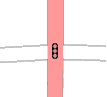 Mapnik
 -
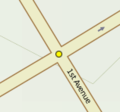 OpenCycleMap
 -
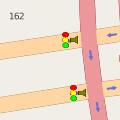 BlindMap. Pedestrian traffic signals with sound


See also
- Relation:enforcement : to define an enforcement traffic signals ;
- Look and Listen Map - Blindmap
- eWorld+SUMO traffic simulation
- Proposed features/Set of Traffic Signals